
the cabin game The Visitor: Your Real Opponent
The monster pawn on the clock track is the threat that does not care about your card hand.
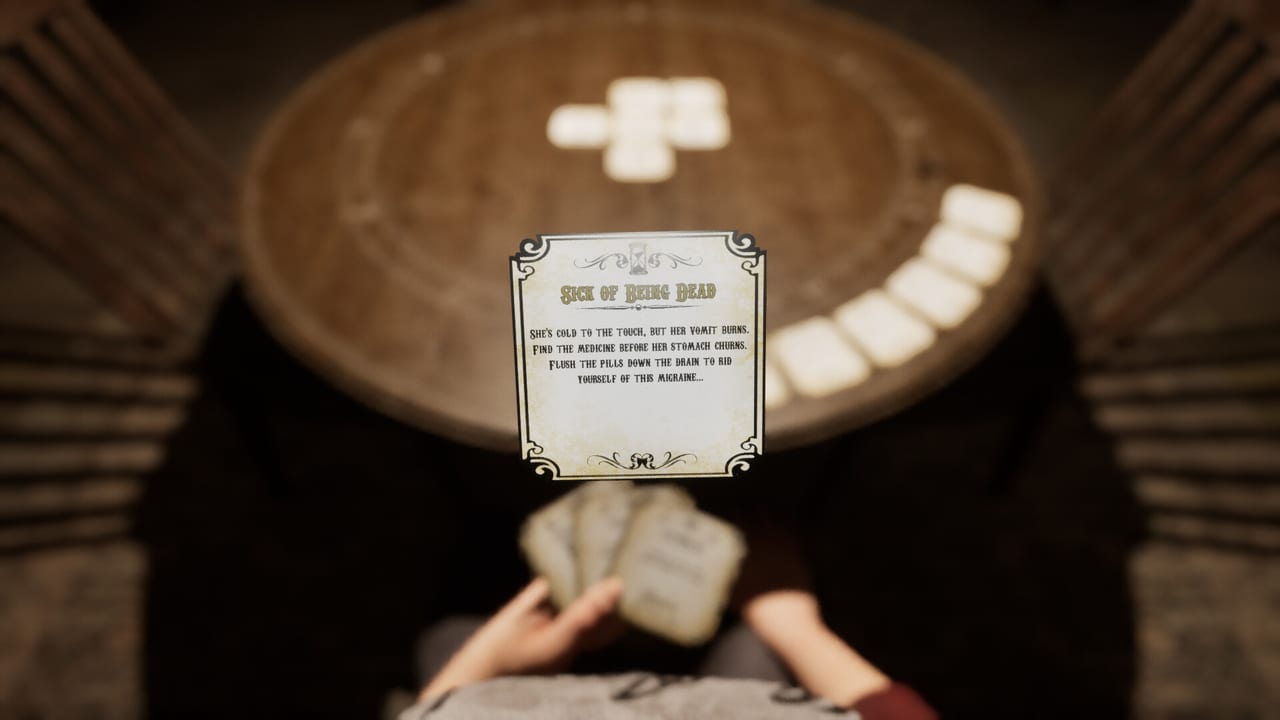
The Visitor is the monster that lives on the clock track. While you are focused on Room Cards, Investigation Cards, and Event Card minigames, the Visitor is moving. It does not announce itself with a cinematic. It does not wait for you to be ready. The clock track around the round table is its path, and every Progress Card you play, every failed Event you survive, every player eliminated during an Event — all of it feeds the same reality: the Visitor is getting closer.
Twisted Corridor’s Early Access build entered Steam on 27 August 2026. The Visitor is present from the first turn. Understanding how it moves, when it kills, and what actually buys you distance from it is the difference between runs that collapse at 11 o’clock and runs that reach the final escape with margin to spare.
How the Visitor moves
The clock track around the round table holds two pawns. One is the shared player pawn — the position your group occupies on the track. The other is the Visitor. Both move forward toward midnight. Progress Cards move the player pawn forward. The Visitor advances on its own, and some cards accelerate it.
The Visitor does not wait for a card to be played. It advances as a function of time and events. Every failed Event, every player eliminated, every card effect that calls for it — the Visitor takes another step. The result is that the track is always in motion. Even when you are sitting safely at the table, the Visitor is walking toward your position.
The gap between the two pawns is your margin. A large gap means you have time to investigate, to place rooms, to survive Events without panic. A small gap means every decision is life or death. A gap of zero means the Visitor has caught you.
What happens when the Visitor catches you
When the Visitor reaches the player pawn on the track, the group receives one final turn. This is not a cinematic chase. This is a mechanical overtime: one turn, one chance to move the player pawn forward away from the Visitor.
To survive, you must start your turn, choose a card, and play a card that moves the player pawn forward before the turn ends. If you play a card that does not advance the player pawn — an Event Card that triggers a minigame, an Investigation Card that does nothing to the track, a Lifesaver that only pushes the Visitor back without advancing your position — the turn ends without progress and the run is lost.
This is why card priority matters. In the overtime moment, you need a card that actually moves the player pawn. If your hand only contains cards that do not advance your position, the overtime turn becomes a coin flip on a deck you did not stack for survival.
The First Round Patch and subsequent updates have not changed this core relationship. The Visitor’s catch mechanic is the hard fail state that lives next to the clock hitting 12.
Keeping distance from the Visitor
Lifesaver Cards push the Visitor back along the track. They do not move your pawn forward. They move the Visitor backward. A well-timed Lifesaver can restore a gap that was collapsing, buying you investigation time or room for a final approach to midnight.
The best Lifesaver plays are preventive. Playing a Lifesaver when the Visitor is one segment from your pawn is a clutch. Playing one when the gap is already large is often wasteful. The skill is reading the track and knowing whether the next few turns will close the gap faster than your hand can respond.
Progress Cards move the player pawn forward. They also advance toward midnight. In the long game, you need both: progress toward the goal and distance from the Visitor. In the short game, sometimes the right move is to play a Lifesaver instead of the Progress Card that looks most urgent.
The Visitor and Event Cards
Event Cards are interruptions. They pull you out of the table rhythm and into a minigame. The threat inside the Event is usually a 3D encounter inside the cabin you built. But the consequence of failing is measured on the clock track.
When you fail an Event, the Visitor often advances. When a player is eliminated during an Event, the shared clock jumps forward by one hour per eliminated player. Both of those are the Visitor getting closer in the only way that matters: the gap closing.
Winning an Event does not usually move you further from the Visitor. It simply stops the advance. That asymmetry is why the Cards Hub ranks investigation above Events, and why stalling with Event Cards is usually worse than stalling with Investigation Cards.
The Visitor in solo versus co-op
The Visitor tracks the shared player position. In solo, that means you are solely responsible for managing the gap. In co-op, the group shares the same position and the same threat. A co-op group that communicates about the track — calling out when the gap is shrinking, assigning one player to monitor the pawns while others investigate — has a structural advantage over a group where everyone watches the 3D chase and nobody watches the table.
The final-hour decision in co-op — escape together, die together, or every player for themselves — is a conversation about the Visitor as much as it is about the escape room. If the Visitor is one segment away and the identified room is across the map, the math may not work for together.
For the monster types that appear in 3D chases, see the Monsters Hub. For card priority that accounts for the Visitor’s movement, see the Cards Hub. For how the final escape works once midnight arrives, see the dedicated Final Escape guide.
Frequently Asked Questions
Quick answers about cards, clues, monsters, and escaping the cabin.
How does the Visitor move on the clock track?
The Visitor advances automatically as turns pass and events resolve. Progress Cards and failed Events can accelerate it. The gap between the Visitor and the shared player pawn is your margin for the rest of the run.
What happens when the Visitor catches the player pawn?
The group gets one final turn. You must start the turn, draw a card, and play a card that moves the player pawn forward before the turn ends. If the card does not advance your position, the run ends.
How do Lifesaver Cards work against the Visitor?
Lifesaver Cards push the Visitor backward along the track. They do not move your pawn forward. The best plays are preventive: use a Lifesaver when the gap is about to close, not after it has already closed.
Does winning an Event push the Visitor back?
Usually no. Winning an Event typically stops the Visitor's advance rather than reversing it. The asymmetry is why Event Cards rank lower than Investigation Cards in practical priority.
Does the Visitor behave differently in solo?
The mechanic is the same. The difference is that a solo player has no one to watch the track while they investigate, and no one to call the gap. Solo players need to build the habit of glancing at the table between every 3D action.