
the cabin game Investigation Cards
How the cabin game's evidence sweep works, why every card you place changes the answer, and where to log what you actually saw.
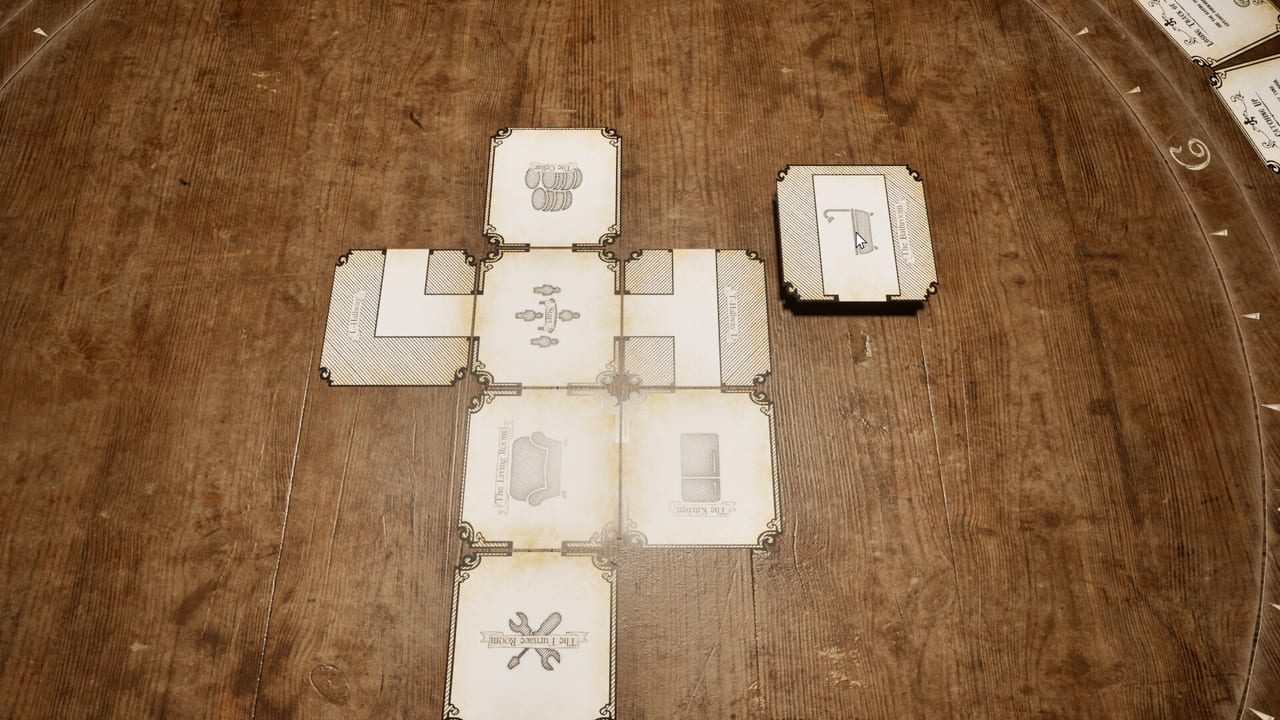
the cabin game treats Investigation Cards like a Phasmophobia evidence sweep wrapped around a horror card game. You sit at the round table, play a card, and an Investigation Card seeds a clue in one of the rooms you have already placed on the floor plan. Then you stand up, walk to that room, and check whether the object the clue refers to actually exists. If it does, you write it down. If it does not, you write that down too — absence is data, and the cabin game is one of the few horror titles where logging a non-finding can win a run.
This page is the dedicated entry for Investigation Cards on the Cards Hub. The full deck and priority are on card types, the Event Cards that often arrive in the same hand are on event cards, and the layout that makes Investigation Cards useful is on room layout.
What an Investigation Card actually does
When you play an Investigation Card, the cabin game selects a room you have already placed on the floor plan and reveals a clue that points at an object inside it. The clue text reads like a riddle: “Find the thing that ticks when nobody is home,” or “Where the cook keeps the cold,” or “A seat you would not want to take at midnight.” You have to walk to that room in first person and check whether the object described actually exists there.
The reason this loop matters is that the cabin is player-designed. The deck of Room Cards you played earlier decides which objects exist in the cabin. If the floor plan does not include a Kitchen, the clue about a fridge resolves as a non-finding. If the floor plan does include a Kitchen, you walk in and look at the fridge. The clue either confirms or eliminates the candidate escape room.
Investigation Cards do not move the clock pawn or the monster pawn on their own. They are pure information. Their only effect is to make a room more or less likely to be the escape room you need to enter before 12 o’clock.
Presence and absence are both data
This is the rule that breaks most first-night groups. When a clue points at an object, the obvious move is to find the object. The non-obvious move is to note that the object is missing, because the cabin is the board you built, not a fixed map.
A useful clue notebook has four fields: room, object, card or trigger, witness. The fifth field, which most groups forget, is whether the object was present. An empty notebook after a clue is not the same as an unsearched room; it is a confirmation that the candidate escape room is less likely to be the right one.
The cabin game’s win condition is to identify the correct escape room from investigation evidence. The correct room is rarely obvious from a single Investigation Card. It is the convergence of several clues, weighted by which rooms have the right objects. A non-finding in The Cellar after a clue about barrels confirms that The Cellar is not where the answer lives. That is information worth writing down.
Why room cards come before investigation
You cannot investigate a room you have not placed. A first-night group that opens with three Investigation Cards and one Room Card ends the night with three riddles and no home for them. The Cards Hub puts Room Cards above Investigation Cards on purpose: investigate is a tool, room is the tool’s toolbox.
Practical opening hand order:
- Play Room Cards first. Two rooms that already share a door are a fine opening (Living Room plus Kitchen is a common start).
- Then play Investigation Cards. Aim for clues that point at objects in rooms you have already placed.
- Hold Event Cards until you understand them. A new event on a blank notebook is a tax, not a payout.
- Spend Lifesaver Cards only when the monster pawn is one sector from tagging you.
- Time-skip cards are last. They burn the clock without adding evidence, which is the worst trade in solo play.
That priority is the entire point of the Cards Hub. Treat it as a working list, not a finished competitive bible. The deck is still growing; the roadmap calls out more Event Card types in the next pass.
Object-dependent clues and what they actually ask
Every Investigation Card clue in the current build points at an object that exists in some Room Card but not in others. Examples that the current build supports:
- A clue about a ticking clock can resolve in The Living Room (which has a grandfather clock) or The Dining Room (which has a wall clock on 12). It cannot resolve in a hallway.
- A clue about cold storage points at The Kitchen (fridge). It does not point at The Cellar, even though The Cellar is also a cold room.
- A clue about hand tools can resolve in The Farmer’s Ranch (tools) or The Garden Shed (hook and scythe). It does not resolve in a hallway.
- A clue about barrels resolves only in The Cellar.
The exact wording on the card matters. “Find the thing that ticks” is not the same as “Find the thing that chimes,” and the difference between grandfather clock and wall clock is the difference between two rooms.
The cabin game does not publish a fixed list of clue-to-object mappings. The First Round Patch added more gameplay tips, but the in-game tip overlay still leaves the final word to the room you walk into. Trust the live card. Trust the room you placed.
Logging clues that you have not yet placed
Sometimes an Investigation Card points at a room you have not placed. The clue text reads like a riddle about a room, and you have to choose: skip the clue, or place a matching Room Card in the next hand so you can resolve it.
If you skip, log it. The notebook line should read: “Clue X — Dining Room — not yet placed — skip.” That tells the table to look for the Dining Room on the next shuffle, or to stop guessing The Dining Room if the rest of the clues point elsewhere.
If you place the matching room, the Investigation Card effectively becomes two actions: the play you just made (placing the room) and the play you will make next (resolving the clue). That is fine in co-op where the table caller is placing rooms and the searcher is walking them. In solo it eats a turn that could have gone to lifesavers or another investigation. Read solo for the trade-off in single-player.
Investigation Cards in solo play
Solo runs bounce sit-stand-sit-stand every turn. Investigation Cards are still the win condition, but the bounce costs you. A solo player who plays an Investigation Card and then spends the next turn walking to the resolved room has spent two turns on what was one play in co-op.
The trick solo players use is clustering. When you play an Investigation Card, plan the next room you will visit. Place the matching Room Card (if you have it) in the same hand. Then stand up once, walk to the room, search the object, return to the table, and log the result. That is one investigation per visit, not two.
Do not use time-skip cards to make solo investigation “faster.” Skipping the clock does not log a clue. The solo page goes deeper on solo time-skip abuse, but the short version is: in solo, time-skips are a habit that lose runs, not a tempo tool.
Investigation Cards and the first-hour habit
If you only have one habit from this page, make it log presence and absence. Investigation Cards are the cabin game’s win condition. A clue notebook that records both what you found and what you did not find is the difference between identifying the correct escape room at 11 and wiping to the monster pawn at 12.
The full evidence-sweep method, including which objects appear in which rooms, is on clues and investigation. The notebook format is on clue notebook.
Frequently Asked Questions
Quick answers about cards, clues, monsters, and escaping the cabin.
Do Investigation Cards move the clock pawn?
No. Investigation Cards are pure information. They seed a clue in a room you have already placed; the only effect is to make a room more or less likely to be the correct escape room. The clock pawn and the monster pawn only move when Progress Cards and Lifesaver Cards are played.
What if the room the Investigation Card points to doesn't exist in my cabin?
That is a non-finding, and it is information worth writing down. Log the room, the clue text, and the fact that the room is not yet placed. The clue notebook format is built to record non-findings, and they often eliminate the wrong escape room faster than a positive clue confirms the right one.
Can I play an Investigation Card before placing any rooms?
Technically yes, but the clue will have nowhere to resolve. A first hand of three Investigation Cards and one Room Card is how most first-night groups end the night with three riddles and no home for them. The Cards Hub puts Room Cards above Investigation Cards on purpose.
Are there unique Investigation Cards on the roadmap?
The roadmap calls out unique Progress Cards, not unique Investigation Cards. The Early Access build has the standard pool of Investigation Cards; new ones are part of the planned content drop, but no dates have been posted. Treat the existing Investigation Cards as the working list.
Why does the in-game tip overlay not always explain a clue?
Because the cabin game's tutorial layer is still being conceptualized. The First Round Patch added more gameplay tips, but the M-key overlay still leaves the final word to the room you walk into. Pair the overlay with clues and investigation and the clue notebook method instead of relying on a single line of tool-tip.
What is the best opening hand?
Two Room Cards that share a door, then one Investigation Card that points at one of those rooms, then a Lifesaver held in reserve. Event Cards and time-skip cards come after you understand the floor plan. That priority is the entire Cards Hub summary in one paragraph.